


You have covered every external variable: the training plan, the long runs, the gear, the nutrition. Yet one thing is almost always missing from your pre-race preparation: a clinical picture of what is happening inside your body.
The Peak Performance programme at Healthway Screening gives you that clinical picture before race day. It is a comprehensive assessment of your cardiovascular, metabolic, and physiological readiness for endurance competition. It does not replace your training. It works alongside your training and sometimes changes it in ways that matter.
What the Peak Performance Screening Assesses
- Cardiac health and structural heart function
- VO2 Max and aerobic capacity
- Cardiovascular risk markers
- Body composition and metabolic health
- Blood markers affecting endurance and recovery
Why Pre-Race Screening Matters for Endurance Athletes in Singapore
Endurance and fitness racing in Singapore is growing rapidly. HYROX Singapore, which debuted in 2023, attracted more than 12,000 participants at the 2025 HYROX Asian Championships. It represents just one format in a broader surge that includes trail running, marathons, triathlons, and obstacle racing.
Every endurance race pushes your heart, lungs, and muscles to their limit. A pre-race health screening establishes whether your body is genuinely ready before that demand arrives.
Why Cardiovascular Health Matters for Athletes
Your heart adapts positively to training; it grows stronger, pumps more efficiently, and beats more slowly at rest. These are healthy changes. However, a small number of people carry underlying heart conditions that look similar and show no warning signs during everyday activity or training. Only a clinical assessment can tell the difference.
"Athletes often assume that because they train regularly, their hearts must be in good health. What clinical screening allows us to do is distinguish normal cardiac adaptation from findings that warrant further investigation before a high-intensity event places additional demand on the heart. The objective is not to alarm athletes, but to give them informed clarity about their cardiovascular readiness."
— Dr Koh Choong Hou, Consultant Cardiologist, Nobel Heart Centre
Cardiac screening, which may include a stress echocardiogram, identifies whether these changes reflect healthy training adaptation or require closer evaluation before race day.
VO2 Max testing goes further, measuring your actual aerobic capacity and giving you precise training zones calibrated to your individual physiology.
Understanding Endurance Capacity and VO2 Max
Most athletes set their training intensities using perceived effort or an age-based heart rate formula, neither of which reflects your individual physiology.
VO2 Max testing replaces estimation with measurement, giving you a verified fitness ceiling and precise training zones calibrated to your actual capacity. It functions as a clinical cardio endurance test that measures the maximum rate at which your body can use oxygen during intense exercise. VO2 Max is widely considered the gold standard measure of aerobic fitness.
Learn more about VO2 Max testing in Singapore
"The value of VO2 Max data is not just the number itself; it is what athletes do with it. When I can show a patient their actual aerobic threshold, the conversation about training intensity changes. They stop guessing and start training to a verified physiological target. That precision makes a measurable difference to both performance and recovery."
— Dr John Cheng, Family Physician, Healthway Medical
Knowing your aerobic capacity is only part of the picture. How your body handles the mechanical load of training and competition matters just as much.
Injury Prevention and Biomechanics Support
Over the course of a training cycle, small movement inefficiencies can compound quietly, often showing no symptoms until race-day intensity pushes them past their threshold.
- Elevated uric acid and other metabolic markers may be associated with inflammation
- Bone health markers can provide an indication of skeletal health relevant to high-mileage athletes
- Body composition data reflects the cumulative load placed on your joints during training and competition
These signals tell you a risk may be present. For endurance athletes, that risk most commonly shows up in the lower limbs — the feet, ankles, and knees absorb the cumulative impact of every training kilometre. A biomechanical assessment identifies where it is coming from.
A podiatrist or physiotherapist examines your gait pattern, foot mechanics, lower limb alignment, and how you absorb load under the specific demands of your sport. For example, for HYROX athletes, the combination of running and heavy loaded movements creates compounding lower limb stress that a training block alone will not surface.
"In endurance and functional fitness athletes, plantar fasciitis is one of the most common presentations we see, and in the majority of cases, it is traceable to a gait or loading issue that has been present for some time. A biomechanical assessment before training intensity peaks gives us the window to intervene effectively, rather than managing an injury in the weeks before a race."
— Mr Jackie Tey, Chief Podiatrist, Straits Podiatry
Note: While podiatric assessment is not part of the Peak Performance programme, it is recommended as a complementary step. Athletes can arrange a separate assessment with Straits Podiatry alongside the Healthway Screening Peak Performance programme for a complete picture of race readiness.
Preparing for HYROX Singapore
HYROX is one of the most physically demanding fitness race formats available. It tests your cardiovascular system and your muscular strength simultaneously, sustained across a 60-to-90-minute effort with no recovery between stations.
What Is HYROX?
HYROX is a global fitness race that combines endurance running with functional workout stations. In Singapore, HYROX has rapidly grown into one of the largest functional fitness races in the region. Athletes complete eight 1 km runs, each followed by functional workout stations including sled pushes, SkiErg, rowing, and sandbag lunges.
How Pre-Race Health Screening Benefits HYROX Athletes
HYROX places significant demands on the heart, lungs, and joints. Cardiac screening evaluates your heart health under that intensity. VO2 Max testing measures your aerobic capacity and defines accurate training zones.
For HYROX athletes, pre-race health screening can help:
- Verify cardiovascular readiness for high intensity racing
- Establish accurate VO2 Max training zones
- Identify potential cardiovascular or metabolic risks early
- Support safer and more effective race preparation
This is where the Peak Performance programme at Healthway Screening comes in.
What the Peak Performance Health Screening Covers
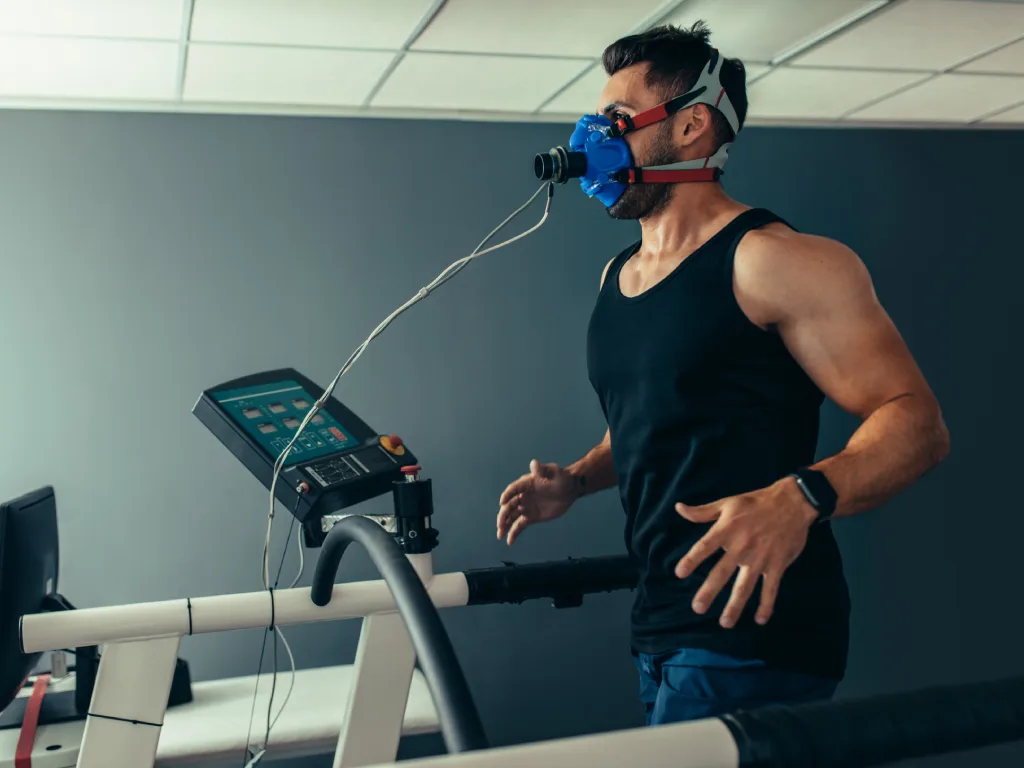
Your heart health and your fitness capacity are connected. If your heart is working under strain, your endurance suffers. If your training zones are set to the wrong intensity, your heart never adapts the way it should. The Peak Performance programme assesses both in a single screening.
Who Is the Peak Performance Health Screening Programme For?
The Peak Performance programme is designed for anyone who trains hard and wants a clear clinical picture of their health and fitness. While it is particularly relevant in the weeks before a race, it is equally suited to high-intensity athletes who train year-round.
Whether you are stepping up to your first race or looking for a clinical edge as a seasoned competitor, the programme is built around what your body needs. It is suitable for:
- Marathon and half-marathon runners
- HYROX competitors
- Triathletes
- Trail runners
- Obstacle and functional fitness racers
- High-intensity gym athletes and functional fitness enthusiasts
- First-time racers and recreational athletes
It is best to schedule your screening 6 to 12 weeks before race day. That window gives you time to act on findings, adjust your training, and complete any follow-up before the final weeks of race preparation.
What Is Included in the Peak Performance Package
- Doctor consultation and physical examination
- Body composition assessment (BMI, body fat, waist and hip circumference)
- Resting 12-lead ECG
- Advanced cardiac risk markers (hs-CRP, Lp(a), Apo A1/B, homocysteine)
- Echocardiogram
- VO2 Max test — choice of treadmill stress test or stress echocardiogram
- Comprehensive blood panel (haematology, lipids, diabetes, liver, kidney, thyroid, bone markers)
- Specialist consultation with cardiologist
- Medical report and lifestyle counselling
What You Can Gain from Peak Performance Health Screening

Unlike a standard health check, the Peak Performance programme is built around what matters for athletic performance. The results are yours to use. Share them with your coach, physiotherapist, or personal trainer to adjust your training in the weeks before race day.
Here is what you can gain from the Peak Performance programme:
- Cardiac clearance with clinical depth.
Not just a basic ECG pass/fail, this programme includes echocardiogram, advanced markers, and a specialist cardiologist review. You leave with a detailed cardiac profile, not just a certificate. - Objective VO2 Max baseline and training zones.
Precise aerobic and anaerobic thresholds based on your measured physiology. The stress echocardiogram variant adds cardiac imaging under exertion, not just at rest. - A shareable clinical report.
Your medical report covers cardiac markers, VO2 Max results, body composition, and the full blood panel, structured for sharing with your coach, personal trainer, or physiotherapist.
Get a clinical picture of where you stand. Then train and race with precision.
Frequently Asked Question
What is the Peak Performance health screening programme?
The Peak Performance programme is a comprehensive cardiac and endurance screening package combining a resting ECG, echocardiogram, advanced cardiac risk markers, VO2 Max testing, a full blood panel, and a specialist cardiologist review. It is designed for high-intensity individuals and athletes who require a clinically rigorous assessment of their cardiovascular health and aerobic capacity before competition.
How soon before a race should I do health screening?
The optimal window is 6 to 12 weeks before race day. That timeframe gives you enough time to review findings with a clinician, recalibrate your training zones using VO2 Max data, arrange any follow-up investigations, and address biomechanical concerns — all before the final weeks of race preparation when training load is highest and interventions are harder to make.
Does this screening apply to race formats beyond HYROX?
Yes. The programme is relevant to any athlete preparing for sustained high-intensity competition. This includes marathon runners, triathletes, trail runners, obstacle racers, and participants in other functional fitness events. The physiological demands that make pre-race screening valuable are common to all endurance and functional racing formats, not specific to HYROX alone.
Should recreational runners do pre-race health screening?
Yes, particularly those preparing for a half marathon or marathon. Marathon training places repeated cardiovascular and joint stress on the body, and screening identifies underlying health risks before that load peaks. VO2 Max data gives recreational runners accurate training zones, helping them avoid injuries caused by overtraining or mismatched intensity.
Can screening improve my race performance?
Yes. Knowing your actual aerobic and anaerobic thresholds allows you to train at the right intensity and accumulate more effective training stimulus. Most athletes currently train at suboptimal intensities because their zones are based on age-formula estimates rather than measured physiology. VO2 Max testing replaces that guesswork with a verified physiological target.
What does cardiovascular screening for athletes involve?
The cardiac component of the Peak Performance programme includes a resting 12-lead ECG to assess heart rhythm and electrical function, an echocardiogram to evaluate the heart's structure and function, and advanced risk markers including hs-CRP, Lp(a), Apo A1/B, and homocysteine. These are reviewed alongside blood pressure measurement and a lipid and glucose panel by a specialist cardiologist.
How much does the Peak Performance health screening cost?
The Peak Performance programme starts from S$2,020 with GST. A stress echocardiogram option, which adds cardiac imaging under exertion rather than at rest only, is available from S$2,455 with GST. Both options include a specialist cardiologist consultation and a full medical report. The programme covers doctor consultation, echocardiogram, VO2 Max testing, advanced cardiac risk markers, a comprehensive blood panel, and lifestyle counselling in a single visit.
Related Articles

Constipation, Bloating & Gas: When It’s from Stress, Not Food
March 04, 2026
Hormonal Health in Women: A Guide to Hormonal Changes, Causes and Symptoms
February 11, 2026